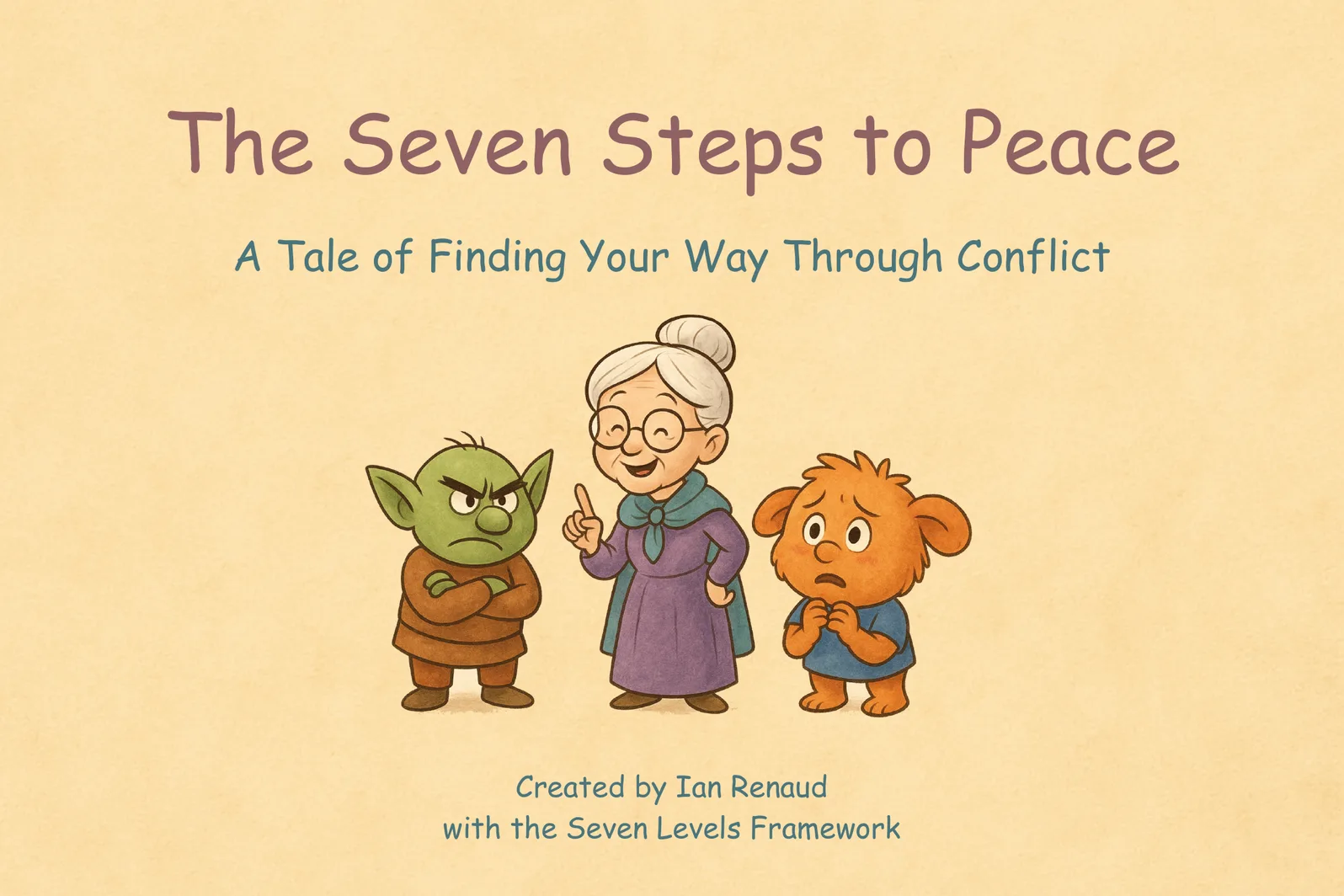
What if a child's first lesson in peace arrived as a story?
The Seven Steps to Peace
A tale of finding your way through conflict.
Based on the Seven Levels Framework from "Resolving From Within" by Ian Renaud
Free | 18 Illustrated Pages | Written to Be Read Aloud
What Most Lessons About Conflict Miss
Most of what children hear about conflict is about behaviour. Say sorry. Share. Use kind words. These are good things to ask. They address the surface. What they rarely address is what is happening inside a child in the moment the conflict begins.
A child who is told to share has often not been helped to notice that they feel afraid of losing something that matters to them. A child who is told to say sorry has often not been given the words for what they actually feel.
Before a child can make peace outside, something needs to be met inside.
The Seven Levels Framework, from the book Resolving From Within, maps seven places where conflict begins. This picture book carries them gently into a child's world. One step per level. Seven steps. A story to read together.
This book is built on one idea:
Peace is not something we hand to children. It is something we help them discover that they already carry.
What Is Inside the Book
In the town of Squabbleville, two groups, the Grumpkins and the Huffles, cannot agree about who a sparkling fountain belongs to. Nobody is listening, and the whole town grows cold. Then wise Old Professor Peacely arrives with seven special steps. Each step is one level of the Seven Levels Framework, told in rhyme.
| The Story | Squabbleville | Two groups, one fountain, and a conflict that nobody knows how to end. |
|---|---|---|
| Step 1 | Make Space Safe | Breathe deep, breathe slow, and find a calm place where everyone feels safe enough to talk. |
| Step 2 | Feel Your Feelings | Name what you feel out loud. Feelings are messengers saying you cared. |
| Step 3 | Remember Your Worth | Your dignity stays, even when you disagree. |
| Step 4 | Build Humble Bridges | Look at each other with curious eyes, and wonder together what might be true. |
| Step 5 | Speak Your True Truth | Say what you really mean, and listen with care. |
| Step 6 | Trust Your Inside Knowing | Notice the quiet whisper that says, "this feels true." |
| Step 7 | See the Big Picture | There is enough room for all. Abundance, not lack. |
| The Last Page | A Note to Grown-Ups | A short note that explains the thinking behind the story, written for the adult who is reading. |
Eighteen illustrated pages. Short enough for one sitting, and gentle enough to return to again and again.
This Book Is For You If...
Children meet conflict long before they have words for it.
At home, in the classroom, on the playground, and inside themselves. This book was made for the adults who walk beside them.
It will resonate if:
- You are a parent or grandparent who would like gentle words for big feelings.
- You are an educator looking for a shared language for circle time and playground disagreements.
- You work with children in counselling or care, and would like a calm, picture-led way to begin a conversation.
- You have noticed that "say you are sorry" does not always reach what is underneath.
- You believe that peace is something children can practise, one small step at a time.
No knowledge of the Seven Levels Framework is needed. This is where the journey begins, for you and for the child beside you.
How It Works
Getting the book is simple, so that the time goes to reading it, together.
| Join the Conflict Intelligence (CIQ) Learning Community to download your copy of the book. Joining is free. | |
| Read it aloud together, one step at a time. Pause on each page and wonder: what might the Grumpkins and Huffles feel here? | |
| Keep the seven steps close. Return to them at bedtime, in circle time, or in a calm-down corner. |
Connect with other participants:
The Conflict Intelligence (CIQ) Learning Community is a place to meet others who read the book with children, ask questions and exchange what you notice. Joining is free, and taking part is always your choice.
The book also works as a shared vocabulary for feelings. Many families and classrooms find that a few simple words, used together, are enough to change the mood of a hard moment.
A story for every kind of moment:
Bedtime reading. Circle time. A quiet corner for calming down. A shared vocabulary for feelings.
Something May Already Be Resonating
If you have read this far, it is likely because something here is familiar to you, not as an idea you have studied, but as something you have lived.
You have watched two children argue over a toy and heard, "It is not fair." You have felt the moment when you were not sure which words would help. You may remember being a child yourself, with a big feeling and no words for it.
The Seven Levels Framework does not teach you something new about conflict. It gives language to something you already know, and this story gives that language a shape a child can hold.
This is not a lesson plan. It is an invitation to read together.
If that line resonates, you are in the right place.
The Peace a Child Practises Has a Ripple
Every time a child finds a word for a feeling, every moment where a disagreement is met with curiosity rather than reaction, something changes beyond the moment itself.
It changes what the other child walks away carrying. It changes the atmosphere of the classroom, the household, the friendship. It changes what becomes possible in the next disagreement, and in the many that follow, long after the story is closed.
The Seven Levels Framework was developed from more than 20 years of work in conflict resolution, mediation and personal development, and from the understanding that lasting peace does not come from better tactics, but from a deeper relationship with our own inner life. This book offers that understanding in the language of childhood.
Peace Comes From Within.
What a child discovers in this story is not a technique to use on others. It is a way of meeting the world.
What Shifts in a Story
By the last page, a child and the grown-up beside them may share something that is easy to overlook: a common language for the moments when peace feels far away.
You may find that you have:
- Simple words for seven places where conflict begins inside us,
- A story you can return to, as often as you like,
- A calm way to begin a conversation after a hard moment,
- A shared vocabulary for feelings, at home or in the classroom,
- A small book for the calm-down corner, the bedside table or the reading circle.
This book is a story. It is not therapy, counselling or professional advice, and it does not promise any outcome. These are descriptions of what the story is designed to offer. How far they go depends on how it is read, and on how it is shared.
Free. 18 illustrated pages. A story to read together.
Seven small steps toward peace, told in rhyme